
Here's the full text of President Ram Nath Kovind's customary address to the joining sitting of Parliament on the first day of the budget session.

For the first time, the Islamic State terror group has released its propaganda song in Mandarin calling on Chinese Muslims to wage Jihad, escalating pressure on security forces battling Uyghur militants in volatile Xinjiang province.

As the context of Panchsheel has changed, it is all the more essential that India and China need to reinvent and redefine Panchsheel for a new world order taking into account globalisation, and mutual economic interdependence. The new Panchsheel, in order to be relevant, needs to shed its binary approach of west verses the east recognising the seamlessness of global frontiers, which globalisation has brought in, says Rup Narayan Das.

Here's the full text of Prime Minister Narendra Modi's address to the United States Congress.

India has built two top-secret facilities in Karnataka to enrich uranium in pursuit of its hydrogen bomb dream.

"Will anybody want a servant that who is on vacation when needed at home? And nobody knows where he is," he continued.

In a veiled reference to Pakistan, India said perpetrators of violence in Afghanistan must not be allowed safe havens in its neighbourhood, as it slammed the United Nations Security Council's sanctions regime for not designating the leader of Taliban as terrorist, calling such an approach a "mystery."

The chief minister skipped meals and remained awake the entire night on a makeshift dais along with some senior ministers and party members.

Pakistan should also be accorded the same 'privilege', the Global Times said.

New Delhi remains a priggish suitor to Washington's overtures, but it has begun appreciating potential tech benefits to ties with the US.
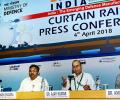
The secretary defence production wants to make India (currently the largest importer of weaponry) one of the world's top five defence manufacturers and a global leader in artificial intelligence and cyberspace.

'It should be of concern that some youth in Kashmir have started raising Daesh flags along with those of Pakistan.'

New Delhi and Beijing are the only two regional capitals that have commented on US President Donald Trump's speech on August 21 outlining the way forward in Afghanistan. The Indian foreign ministry statement was effusive in praise, while the Chinese statement has been one of cautious and guarded hope. Delhi has identified itself with Trump's Afghan strategy, whereas the Chinese stance is calibrated -- observant and objective, keeping a distance, says Ambassador M K Bhadrakumar.
'It's a matter of great pride that no student of Army Goodwill Schools has ever joined terrorism.'

"The RSS is trying to change the nature of India. Other parties haven't tried to capture India's institutions," he said.

It was clear in Brunei at the 8th East Asia Summit that China doesn't want the South China Sea issue to even dominate the discussion, reports Sheela Bhatt, who is part of the prime minister's media contingent to the summit

Council on Foreign Relations Senior Fellow Daniel Markey Tuesday said that the raising of the issue of American intervention in Jammu and Kashmir by visiting Pakistani Prime Minister Nawaz Sharif at the United States Institute of Peace in Washington was not 'especially constructive' and was motivated by political expediency.
Thousands of police personnel have been deployed across the state to maintain law and order.
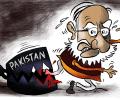
For the first time in our political history, Pakistan has become centre stage of the incumbent's campaign, points out Shekhar Gupta.

Diplomats agree that amid stormy relations with China and Pakistan, Modi has posted impressive foreign policy successes, notes Aditi Phadnis.

'This novel format of diplomacy -- the informal summit -- will not only facilitate bilateral communication and reduce miscalculations at the very top level of the two governments, but possibly open the space for China and India to speak in one voice on various issues of mutual concern,' note Feng Renjie and Ding Kun Lei

Mukherjee extended an invitation to Xi to visit India which he accepted.

Asserting that there was growing scourge of terrorism in view of fast growing linkages of terrorist groups across the globe, India on Tuesday strongly advocated stepped up cooperation through intelligence exchange and training with 54 African countries.
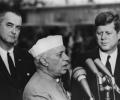
As Prime Minister Narendra Modi begins his historic visit of the United States of America, here's a look at some landmark visits by Indian prime ministers to the United States of America.

More than 60 per cent followers of Mehdi Masroor Biswas, the Bengaluru-based executive, who was running a pro-Islamic State Twitter account, were non-Muslims and a majority of his Muslim followers were from western countries, particularly the United Kingdom, Home Minister Rajnath Singh said on Monday.
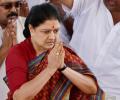
If the people of Tamil Nadu stop deifying their leaders and start evaluating them more objectively, the political masters too may change their wayward behaviour, argues Sudhir Bisht.

Sharad Yadav came out all guns blazing against Jitan Ram Manjhi for causing damage to the party.
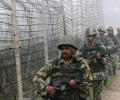
'As India progresses and takes an increasingly hardline approach to Pakistani hostility, the young and restless population of Pakistan, sooner than later, will demand 'Gazwa e Hind' (conquest of India),' warns Colonel Anil A Athale (retd).

King Salman and Narendra Modi will find common ground to intensify cooperation against jihadi terrorism, says Tarun Vijay, MP.

We take a look at Time magazines top world leaders.

Indian authorities failed to "prevent many incidents of religious violence and contributed to tensions through polarising speeches", Amnesty International said.

India is keen on the issue of equal share holding since it doesn't want a repeat of the distortions that have crept into Bretton Woods institutions like International Monetary Fund, World Bank and the Asian Development Bank in which rich countries like the US and Japan have a strangle hold.
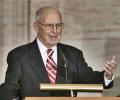
The work of Norman Borlaug, who helped save billions from starvation, is worth recalling, especially as opposition to gene-modified crops mount, says Shreekant Sambrani.

Pakistan Prime Minister Nawaz sharif warns that continuing US drone strikes will be a detriment to his country's efforts to eliminate terrorism; but the White House defends these strikes and vows to continue despite condemnation from the un and amnesty international too. Aziz Haniffa reports

This is the first time the Pakistan army has publicly backed the arrest of India-focused jihadis.

'It was the Mughals who first established standard units of measurement and maintained offices of meticulous record keepers and auditors, departing from the more haphazard methods of earlier regimes.' 'By the end of the 16th century, their revenue and judicial administrations exhibited an obsessive preoccupation with order, the efficient management of time, and a spirit of rational self-control -- all of them characteristics of early modernity,' point out Sheldon Pollock and Benjamin Ellman.

'The US-India relationship is in a different league altogether,' Obama administration officials tell Aziz Haniffa/Rediff.com in Washington, DC.

Addressing the Indian diaspora on the second day of his three-day visit to Malaysia, Modi said India draws strength from its diversity and that his government is working to create an environment where enterprise flourishes and everybody gets basic needs like roof, sanitation, water, health care and education.

Prime Minister Narendra Modi had invited ASEAN leaders to be the chief guests.

 © 2026 Rediff.com - Advertise with us - Disclaimer - Privacy Policy - Sitemap - Feedback - About us - Terms of use - Grievances